
Artificial intelligence has moved from being a futuristic idea to becoming a practical part of everyday life. In 2026, AI tools are being used by students, teachers, content creators, developers, businesses, freelancers, researchers, and ordinary internet users to complete tasks faster and discover new ways of working.
Whether you want to write an article, understand a difficult subject, generate ideas, create images, analyze information, write code, or improve your productivity, there is probably an AI tool designed to help.
However, the growing number of best AI tools 2026 platforms can also make choosing the right tool confusing. Some tools are better for writing and research, while others are designed for coding, image generation, presentations, productivity, or real-time information.
In this guide, we will look at some of the most useful AI tools to try in 2026, with particular attention to ChatGPT, Google Gemini, and Grok. We will also discuss how to choose the right AI tool, how students and creators can use AI effectively, and what you should keep in mind when working with AI-generated information.
What Are AI Tools?
AI tools are software applications that use artificial intelligence to perform tasks that normally require human intelligence. Depending on the tool, AI can understand text, recognize images, generate content, analyze information, write computer code, create graphics, summarize documents, and assist with problem-solving.
Modern AI assistants can understand natural language, which means you can communicate with them in a conversational way instead of learning complicated commands.
For example, instead of searching through dozens of websites to understand a difficult topic, you can ask an AI assistant to explain the topic in simple language. You can then ask follow-up questions and request examples until the concept becomes clear.
This makes AI particularly useful for education, productivity, research, and content creation.
Why Are AI Tools Important in 2026?
The biggest advantage of AI is not simply that it can generate text. AI can help people reduce repetitive work and spend more time on important tasks.
A student can use AI to organize study material. A blogger can use it to brainstorm article ideas. A programmer can use it to understand code. A business owner can use AI to create marketing ideas. A designer can use AI-powered creative tools to develop concepts.
AI can also help beginners enter areas that previously required advanced technical skills.
For example, someone with limited design experience can use AI to develop an initial visual concept. Someone who is not an experienced writer can use AI to organize their ideas into a structured article.
The important point is that AI should be treated as an assistant, not as a replacement for human judgment.
1. ChatGPT
ChatGPT is one of the most widely recognized AI assistants. It can be used for writing, learning, brainstorming, research assistance, coding, summarization, planning, and many other tasks.
One of its biggest advantages is its conversational approach. You can start with a simple question and continue asking follow-up questions based on the response.

For example, a student could ask:
“Explain photosynthesis in simple words.”
After receiving the explanation, the student could ask:
“Give me an example.”
Then:
“Create five multiple-choice questions.”
This makes AI useful as an interactive learning assistant. And
This is the best AI tools 2026
What Can You Use ChatGPT For?
ChatGPT can be useful for many different activities, including:
- Writing blog posts and articles
- Generating content ideas
- Creating outlines
- Explaining difficult subjects
- Summarizing text
- Brainstorming
- Coding assistance
- Debugging
- Creating study notes
- Preparing practice questions
- Improving writing
- Translating and rewriting text
- Creating business ideas
- Organizing information
It can also help users turn a rough idea into a structured project.
ChatGPT for Students
Students can use AI to make studying more organized. Instead of simply asking for an answer, students can ask AI to teach them a topic step by step.
For example, if a student is struggling with statistics, they can ask for a simple explanation of mean, median, mode, standard deviation, or regression and then request practice questions.
However, students should avoid simply copying AI-generated answers. The goal should be to understand the subject.
A better approach is to ask AI to explain, quiz, test, and correct you.
2. Google Gemini
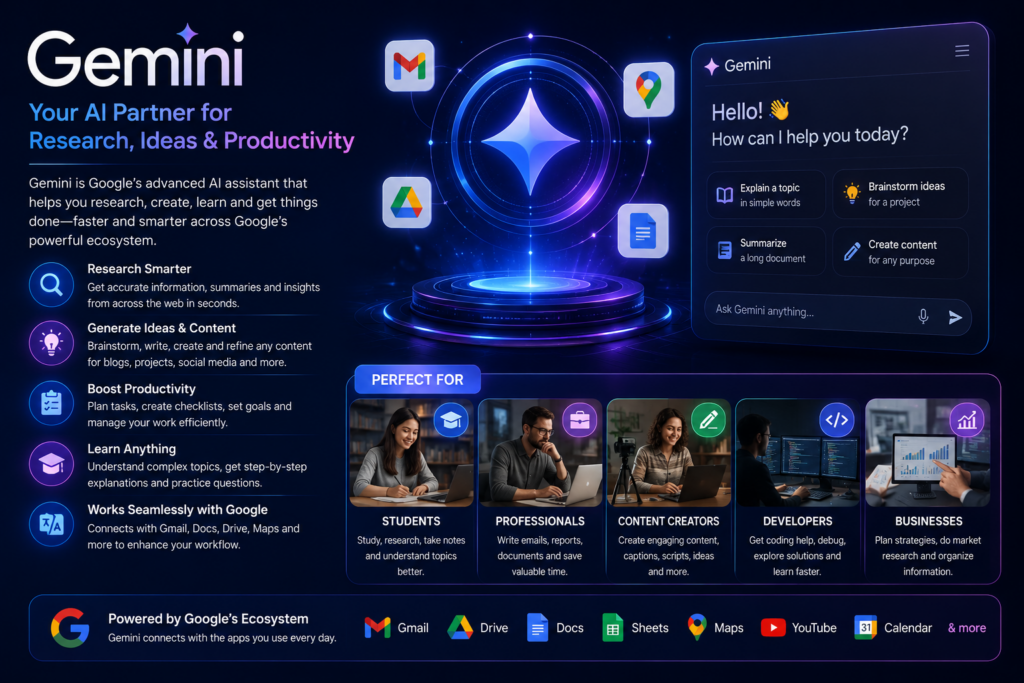
Google Gemini is Google’s AI assistant and is another major option for people who want to use artificial intelligence for research, writing, brainstorming, learning, and productivity.
One reason Gemini attracts users is its connection to Google’s broader technology ecosystem.
Gemini can be useful for people who already rely heavily on Google services and want an AI assistant as part of their everyday digital workflow.
What Can You Use Gemini For?
Gemini can be used for activities such as:
- Research assistance
- Writing and rewriting
- Brainstorming
- Learning
- Summarizing information
- Generating ideas
- Productivity
- Analyzing content
- Planning projects
- General question answering
For students, Gemini can be useful when researching a subject or looking for different explanations of a difficult topic.
For professionals, it can help organize ideas, draft content, and support everyday productivity.
Why Try Gemini?
One important reason to try multiple AI assistants is that different systems may approach the same question differently.
You might ask ChatGPT and Gemini the same question and compare their explanations. This can help you identify missing information, discover alternative perspectives, and decide which response is more useful.
However, different answers do not automatically mean that one system is correct. Important facts should still be verified using reliable sources.This is the one of the best AI tools 2026.
3. Grok
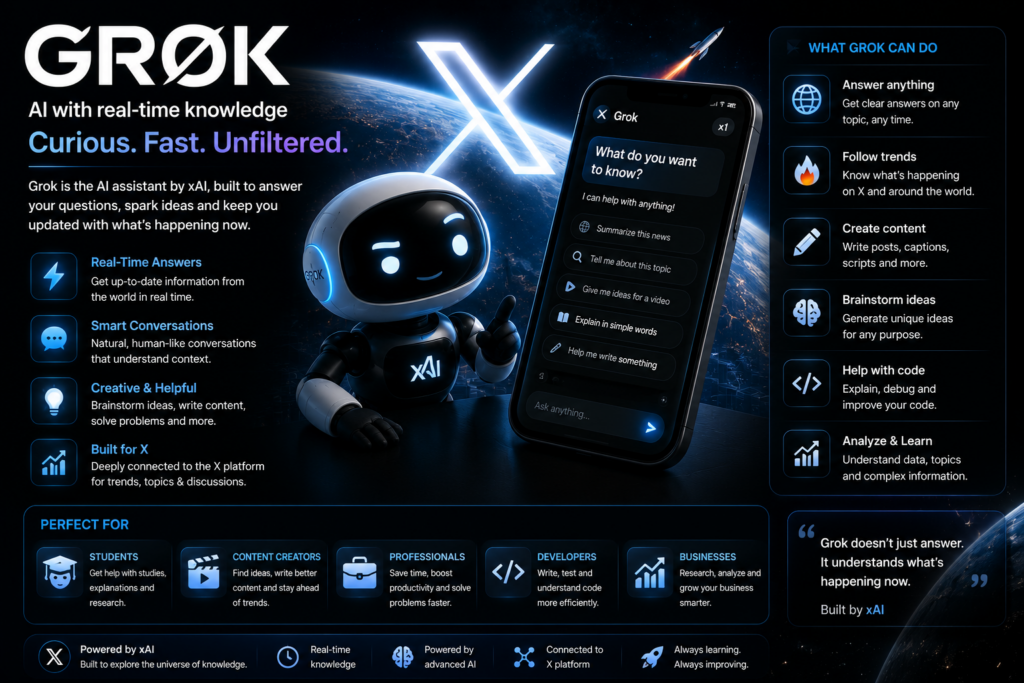
Grok is an AI assistant developed by xAI. It has gained attention for its conversational style and its relationship with the X platform.
Grok can be useful for brainstorming, general questions, creative tasks, discussions about current topics, and exploring ideas.
One of its interesting characteristics is its focus on conversational interaction and information connected to online discussions and trends. This is also the best AI tools 2026.
What Can You Use Grok For?
Grok can be useful for:
- Brainstorming
- Creative writing
- Generating ideas
- Discussing current topics
- Exploring trends
- General questions
- Content ideas
- Conversational research
- Social media-related brainstorming
For content creators, exploring what people are discussing can be useful when developing ideas for videos, articles, posts, and other forms of online content.
As with any AI system, however, information about current events should be checked against reliable sources before being treated as fact.
ChatGPT vs Gemini vs Grok
There is no universal winner because each AI assistant can be useful for different purposes.
| AI Tool | Useful For |
|---|---|
| ChatGPT | Writing, learning, coding, brainstorming and productivity |
| Gemini | Research, productivity and Google-related workflows |
| Grok | Trends, conversations, brainstorming and current topics |
If your primary goal is writing, studying, coding, or general productivity, ChatGPT can be a strong starting point.
If you regularly use Google’s ecosystem and want an AI assistant that fits naturally into that environment, Gemini is worth exploring.
If you are interested in online discussions, trends, brainstorming, and conversational interaction, Grok may be useful.
The best solution for many users is actually to try all three best AI tools 2026.
AI Tools for Students
Students are among the groups that can benefit significantly from AI tools.
AI can act like a study assistant that is available whenever you need an explanation or practice exercise.
For example, students can ask AI to:
- Explain a chapter in simple language
- Create revision notes
- Generate practice questions
- Create flashcards
- Explain mathematical formulas
- Give examples
- Check grammar
- Help organize assignments
- Create a study schedule
- Test their understanding
However, there is an important difference between using AI to learn and using AI to avoid learning.
If a student simply copies an AI-generated assignment, they may complete the task without actually understanding the subject.
A better strategy is to use AI as a tutor. Ask it to explain the concept, then close the AI tool and try to explain the concept yourself.
AI Tools for Bloggers and Content Creators
AI has also changed the way bloggers and content creators work.
A creator can use AI during almost every stage of content production.
The process can begin with brainstorming.
For example:
Topic: Best AI Tools 2026 for students.
AI can help generate possible article ideas such as:
Best AI Tools 2026 :
- Best AI tools for university students
- Free AI tools for studying
- AI tools for writing assignments
- AI tools for research
- AI tools for productivity
After selecting a topic, AI can help create an outline.
The creator can then research the subject, write the article, edit the content, create a featured image, and optimize the article for search engines.
However, human editing remains important. AI-generated content can sometimes sound repetitive, generic, or inaccurate.
Adding personal experience, examples, original explanations, screenshots, comparisons, and useful recommendations can make an article much more valuable.
AI Tools for Businesses
Small businesses can also benefit from artificial intelligence.
A business owner may use AI for:
- Marketing ideas
- Customer-support drafts
- Product descriptions
- Social media content
- Email writing
- Research
- Business planning
- Data organization
- Brainstorming
- Advertising ideas
For a small business with limited resources, AI can help reduce the amount of time spent on repetitive content tasks.
For example, instead of starting every social media post from a blank page, a business owner can ask an AI assistant to generate several concepts and then personally select and improve the best one.
AI and Coding
AI has become increasingly useful for programmers and people who are learning programming.
Beginners can ask AI to explain programming concepts in simple language. Experienced developers can use AI to investigate errors, generate examples, or explore possible solutions.
For example, instead of asking only:
“Write Python code for this task,”
a learner can ask:
“Write the Python code and explain every important line so I can understand how it works.”
This approach makes AI more useful as a learning tool.
Programmers should still test generated code carefully. AI-generated code can contain bugs, security problems, or incorrect assumptions.
AI for Research
AI can make the early stages of research faster.
You can use AI to brainstorm research questions, organize topics, identify keywords, summarize material, and create an initial structure.
However, AI should not automatically be considered a reliable source.
When writing academic or professional material, verify important claims using primary sources, official websites, research papers, reputable publications, or other trustworthy references.
This is especially important when dealing with statistics, medical information, financial information, laws, scientific claims, or rapidly changing technology.So for best AI tools 2026.
How to Choose the Right AI Tool
With so many AI tools available, choosing one can feel overwhelming.
Start by identifying your goal.
If you want to write:
Try an AI assistant that is strong at language generation, editing, brainstorming, and organization.
If you want to study:
Choose a tool that can explain concepts interactively and generate practice questions.
If you want to code:
Look for an AI assistant that can explain code, identify errors, and help you understand programming concepts.
If you want to create images:
Use an AI-powered image generation or design platform.
If you want current information:
Use tools that provide access to current information and still verify important claims.
The best AI tool is ultimately the one that fits your workflow.
How to Write Better Prompts
The quality of an AI response often depends on the quality of your instructions.
Instead of asking:
“Write an article about AI.”
Give the AI more information.
For example:
“Write a 2,000-word beginner-friendly article about AI tools for students. Use clear headings, examples, a comparison table, and a frequently asked questions section. Keep the language simple and practical.”
This gives the AI a much clearer objective.
A good prompt usually explains:
- What you want
- Who the content is for
- The desired format
- The desired length
- The tone
- Important information that must be included
Learning how to write better prompts is becoming an important digital skill.
Don’t Depend Completely on AI
Although AI tools are powerful, they have limitations.
AI systems can sometimes make mistakes. They may misunderstand a question, provide outdated information, invent details, or present an uncertain answer confidently.
This means users need to develop the habit of checking important information.
Think of AI as a powerful assistant.
A good assistant can help you work faster, but you are still responsible for checking the final result.
This is particularly important for:
- Medical decisions
- Financial decisions
- Legal matters
- Academic research
- News and current events
- Business decisions
- Technical security
Use AI to accelerate your work, but use your own judgment to make the final decision.
The Future of AI Tools
AI is likely to become even more integrated into everyday software.
Instead of opening a separate AI website for every task, people may increasingly interact with AI directly inside the applications they already use.
AI assistants are also becoming more capable of handling multiple types of information, including text, images, documents, audio, and other forms of content.
For users, this means that learning how to work with AI today can provide useful digital skills for the future.
The most valuable skill may not be knowing one specific AI tool. Tools will continue to change.
Instead, users should learn how to:
- Ask clear questions
- Evaluate AI responses
- Verify information
- Give useful instructions
- Combine AI with human creativity
- Edit and improve AI-generated content
- Use different tools for different tasks
Frequently Asked Questions
Which AI tool is best in 2026?
There is no single Best AI Tools 2026 that is best for everyone. ChatGPT, Gemini, Grok, and other AI platforms have different strengths. The best option depends on whether you need help with writing, research, coding, studying, creativity, productivity, or current topics.
Is ChatGPT useful for students?
Yes. Students can use ChatGPT to understand difficult concepts, create practice questions, organize notes, brainstorm ideas, and study interactively. Students should use it to improve understanding rather than simply copying answers.
Is Gemini better than ChatGPT?
Neither is automatically better for every task. Both can be useful for different workflows. The best approach is to try both and determine which one provides the type of assistance you need.
What is Grok mainly used for?
Grok can be useful for general questions, brainstorming, creative tasks, conversations, trends, and discussions involving current online topics.
Are AI tools free?
Many AI services offer free access with limitations, while some features or higher usage limits may require paid plans. Pricing and available features can change over time, so check the official service before subscribing.
Can AI replace human writers?
AI can help with many parts of writing, but human judgment, experience, creativity, fact-checking, and editing remain important. The strongest results often come from combining AI assistance with human input.
Should I use more than one AI tool?
Yes. Using multiple AI tools can be useful because different systems may provide different approaches to the same problem. Comparing responses can help you identify better ideas and potential mistakes.
Final Thoughts
Artificial intelligence is no longer just a technology for researchers and large companies. In 2026, AI tools are available to students, creators, freelancers, businesses, developers, and everyday users.
ChatGPT, Gemini, and Grok are three important Best AI Tools 2026 assistants worth exploring, but they are only part of the rapidly growing AI ecosystem.
The most effective way to use AI is not to search for one perfect tool. Instead, understand what you are trying to accomplish and choose the tool that fits that task.
Use AI to generate ideas, learn faster, organize information, automate repetitive work, and explore possibilities. At the same time, verify important information, think critically, and add your own experience and creativity.
The future of AI will continue to change quickly. New tools will appear, existing platforms will improve, and the way people work with technology will continue to evolve.
The people who benefit most from AI will not necessarily be those who use the most tools. They will be the people who understand how to use AI effectively, responsibly, and creatively.
If you are just getting started, begin with one or two AI tools, experiment with different prompts, and gradually discover which tools work best for your needs.
AI is a tool. Your ideas, judgment, and creativity are what make the tool valuable.
Pingback: Best Daily Use Apps in 2026: Essential Apps for Everyday Life
yes ofcourse